A diesel engine parts diagram turns a complex machine into something you can read at a glance. Instead of guessing where a piston, liner, or gasket sits, you can trace each component, understand how the assemblies connect, and order the correct Baudouin replacement with confidence. This visual guide walks through a typical diesel engine parts diagram section by section, explains what every major part does, and links each component to the right Baudouin spare part for M-series and related engine families.
Reading a Diesel Engine Parts Diagram
Most engine diagrams are drawn as a cutaway or an exploded view, with callout lines pointing to each component and a numbered parts list alongside. The top of the drawing usually shows the cylinder head and the valve train, the middle shows the pistons and cylinder liners inside the block, and the bottom shows the crankshaft and oil pan. A cutaway shows the engine as if sliced open so you can study internal clearances, while an exploded view separates every part so you can see how they stack together. Learning to read these layers is the fastest way to understand what a technician means when they describe a knock, a leak, or a worn bore. Always cross-reference the diagram with your exact engine model, because M-series engines differ in cylinder count and component fitment.
Top Section: Cylinder Head, Valves, and Gaskets
The upper portion of a diesel engine parts diagram shows the cylinder head bolted over the block. Inside it sit the intake and exhaust valves, the valve guides and seats, the valve springs, and the fuel injectors. The head gasket appears as the thin sealing layer between the head and the block, and it is usually drawn together with the rocker cover and the valve cover gasket. A failed gasket is a common cause of compression loss, coolant contamination, and overheating, so it is replaced during most top-end overhauls. A complete Baudouin full engine gasket set covers the head gasket, valve cover gasket, and cylinder gasket in one convenient kit.
Middle Section: Pistons, Rings, and Cylinder Liners
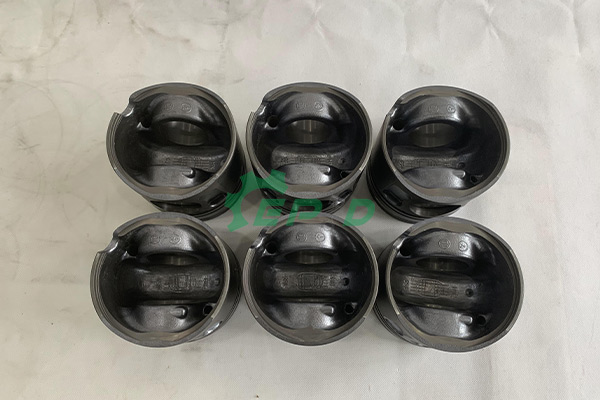
The middle of the diagram is where combustion happens, and it is the section most rebuilders study first. Each cylinder shows a piston connected to a connecting rod, with piston rings seated in the grooves around the crown. The piston travels inside the cylinder liner, the replaceable sleeve that is pressed or fitted into the block. Diagrams label these parts separately because they wear at different rates, even though they work as one unit. When the bore is scored or the rings are stuck, you will usually replace the liner and piston together. Baudouin OEM piston and ring sets and matching cylinder liners are available for 4M, 6M, 12M, and 20M engine families.
Bottom Section: Crankshaft, Bearings, and Lubrication
The lower section of a diesel engine parts diagram shows the crankshaft supported by the main bearings, with connecting-rod bearings linking it to each piston. The oil pump, oil pickup tube, and oil filter are usually drawn nearby because they feed the lubrication circuit that keeps those bearings alive. The flywheel and its housing also appear at the rear of the diagram, where the engine connects to the transmission or the generator. Understanding this layer helps you connect symptoms to parts: low oil pressure often points to the pump or to worn bearings, while a deep knock from the lower engine usually points to the rod bearings or the crankshaft journals.
Using the Diagram to Order the Correct Parts
A diagram is only useful if it matches your engine. Note the engine model, cylinder configuration, and serial number, then compare the drawing to the physical component before you order. Take the time to confirm which side of the engine you are looking at and whether the drawing shows a complete assembly or only the section you are replacing. When you are ready, browse the Baudouin engine parts category to find diagram-matched pistons, liners, gaskets, and other components for your engine series.
Frequently Asked Questions
Why is a diesel engine parts diagram useful when buying parts?
A diagram lets you identify the exact component and its position before you order, which reduces wrong-part returns and saves downtime. It is especially helpful when you need to describe a fault to a supplier or confirm fitment for your engine model.
Where do pistons and cylinder liners appear on the diagram?
They appear in the middle section of the diagram, inside the cylinder block, and are usually shown as a matched pair. You can find compatible Baudouin piston and ring kits for your engine family.
Are Baudouin parts diagrams the same across engine series?
No. M-series engines differ in cylinder count, bore, stroke, and component fitment, so a diagram for one model will not necessarily match another. Always use a diagram that corresponds to your exact engine model.


